COA Review Checklist for Plant Ingredients: What Buyers Should Confirm
A buyer-focused checklist for reviewing Certificate of Analysis data, including assay, identity, microbiology, heavy metals, pesticide residues, moisture and batch traceability.
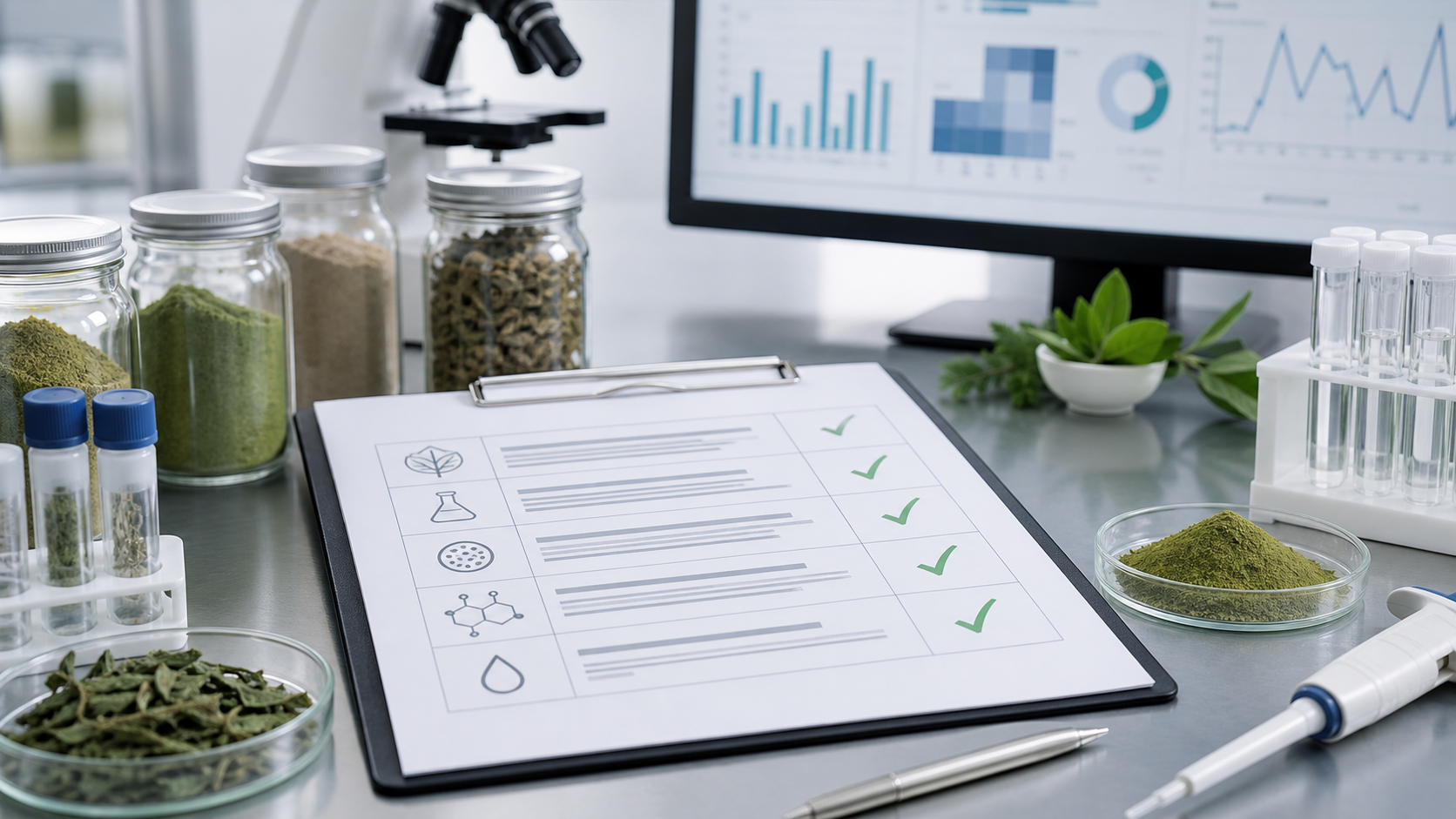
What a COA can and cannot prove
A Certificate of Analysis is one of the most important documents in botanical ingredient sourcing. It shows test results for a specific batch, but it should not be reviewed as a standalone promise. Buyers should compare the COA against the agreed specification, target market requirements and intended application.
A COA is useful when it is current, batch-specific and consistent with the supplier specification. A generic or outdated COA has limited value for purchase decisions.
Check batch identity first
Start with the basic information. The COA should identify the product and the batch clearly enough to connect the document to the actual material being quoted or shipped.
Review these fields:
- Product name
- Batch number
- Manufacturing date
- Expiry or retest date
- Specification version
- Supplier or manufacturer name
- Test date or release date
If the batch number is missing, ask for a current-batch COA before final approval.
Compare assay result with specification
For standardized extracts, the active marker result is often the most commercially important line. Confirm the marker name, unit, test method and acceptance range.
For example, if the specification says polyphenols 10 percent minimum, the COA should show the actual tested result and the test method. If the result is very close to the lower limit, buyers may want to ask about batch consistency before bulk purchase.
Review moisture and physical indicators
Moisture affects storage stability, flowability, microbiology risk and sometimes price fairness. For powders, also review appearance, color, odor, mesh size and bulk density if these are important to the formulation.
Questions to ask:
- Is moisture within the agreed limit?
- Is the color consistent with the approved sample?
- Is mesh size tested or only declared?
- Is the powder suitable for the target dosage form?
Do not skip microbiology
Microbiology results are especially important for ingredients used in supplements, beverages, powders and functional foods. Common items include total plate count, yeast and mold, E. coli, Salmonella and sometimes Staphylococcus aureus.
If the target market or finished product has stricter requirements, confirm the acceptable limits before ordering.
Review contaminants by market risk
Heavy metals and pesticide residues should be reviewed according to the target market and product type. Some products naturally require closer attention because of raw material origin, plant part, concentration process or intended consumer group.
Common contaminant checks include:
- Lead
- Arsenic
- Cadmium
- Mercury
- Pesticide residues
- Aflatoxins where relevant
- PAH where relevant
Confirm document consistency
The COA should match the specification sheet, sales contract and product label description. If the product is described as organic, allergen-free, non-GMO or solvent-free, supporting documents should be available when required.
Procurement takeaway
Use the COA to confirm batch reality, not only supplier claims. The best practice is to request a current-batch COA after confirming specification, application, market and order quantity.