How to Read a Botanical Extract Specification Sheet Before Requesting a Quote
A practical guide for procurement teams reviewing active markers, extract ratios, solvents, mesh size, microbiology, contaminants and commercial terms before comparing suppliers.
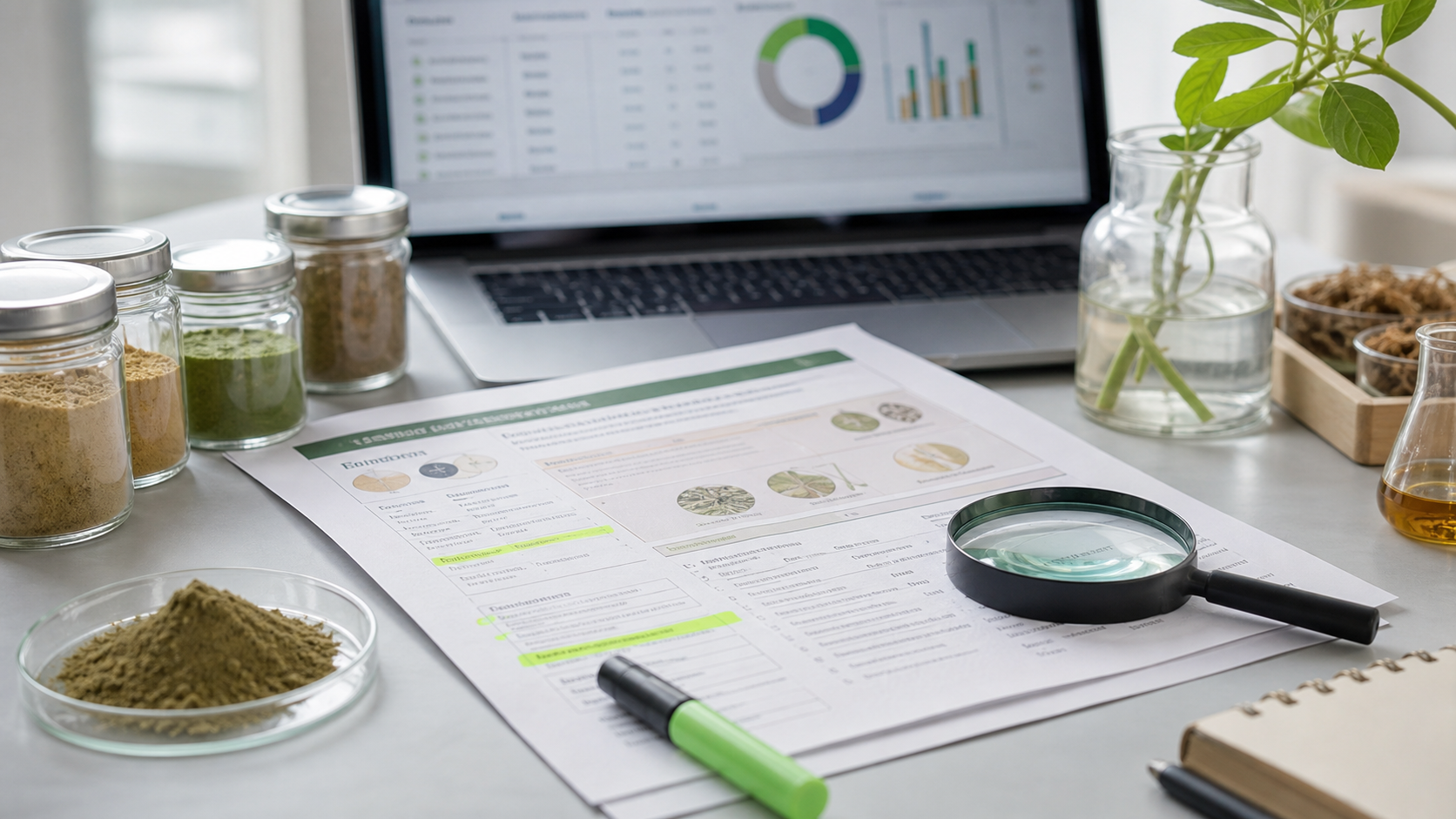
Why the specification sheet matters before price comparison
A botanical extract quote is only useful when the specification behind the price is clear. Two suppliers may both offer the same product name, but the actual material can be different in active marker, extract ratio, solvent system, carrier, particle size, microbiology limits, packaging and batch documentation.
For international B2B buyers, the specification sheet is not just a technical file. It is the starting point for supplier comparison, sample testing, internal approval and purchase order risk control.
Start with the product identity
Check whether the specification clearly states the botanical name, plant part used and processing type. A common name alone is not enough. For example, the same herb name may refer to different species or plant parts, which can affect active compounds, color, taste, compliance and application performance.
Key identity fields to review:
- Product name
- Botanical name
- Plant part used
- Country or region of raw material when relevant
- Processing method
- Extract ratio or active marker
If these fields are missing, ask the supplier to confirm them before discussing bulk price.
Do not treat extract ratio as the same as potency
An extract ratio such as 10:1 describes the relationship between raw material input and extract output. It does not automatically prove a higher active compound level. A standardized extract should also identify the active marker, assay range and test method.
Useful questions to ask:
- Is the material standardized by active marker or only by extract ratio?
- Which test method is used?
- Can the supplier provide current-batch COA?
- Is the ratio native extract only, or does it include carrier?
Review physical parameters by application
Mesh size, solubility, bulk density, color and odor can be as important as assay for formulation. A capsule manufacturer may care about flowability and bulk density. A beverage developer may care about solubility, sedimentation and taste impact.
For capsules and tablets, check:
- Mesh size
- Bulk density
- Flowability
- Moisture
- Microbiology
For beverages and instant powders, check:
- Water solubility or dispersibility
- Sedimentation risk
- Carrier system
- Taste and color impact
- Heat stability if processing is involved
Confirm quality limits and documents
A good specification should define limits for moisture, ash, microbiology, heavy metals and pesticide residues where applicable. For regulated or brand-sensitive markets, ask for the document list before sample approval.
Common documents include:
- Current-batch COA
- TDS or specification sheet
- SDS
- Allergen statement
- Non-GMO statement
- Heavy metal and pesticide testing report
- Halal, Kosher or Organic certificate when applicable
Commercial information still belongs in the review
A product can be technically suitable but commercially impractical. Before comparing suppliers, confirm MOQ, packaging, lead time, sample availability, shelf life and export documentation support.
Procurement takeaway
Before requesting a quote, make sure the specification answers three questions:
- What exactly is the material?
- Can the supplier prove the quality by batch documents?
- Will the material work for your application and purchase plan?
If any of these questions are unclear, request clarification before treating prices as comparable.